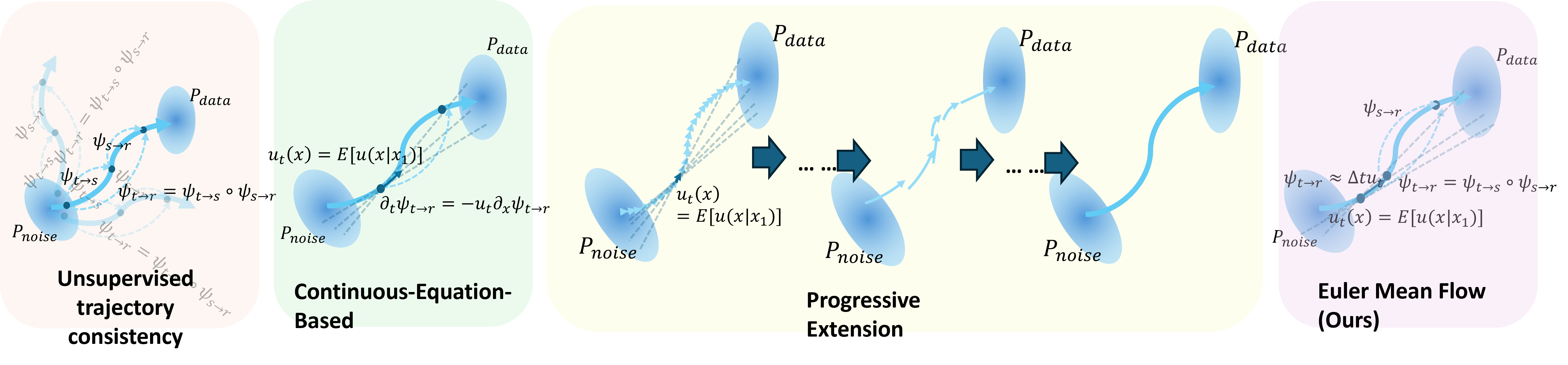
Progressive extension
ShortCut, PSD, and SplitMeanFlow extend short maps to long
maps through consistency. Their long maps are learned from
model outputs, not direct dataset supervision.
\[
\left\|
u^\theta_{t\to t}(x)
-
u_1(x\mid x_1)
\right\|^2,\qquad
u_1(x\mid x_1)=\frac{x_1-x}{1-t},\;x_1\in\mathcal D
\]
\[
\left\|
u^\theta_{t\to t+2d}(x_t)
-
\frac{1}{2}
\left[
u^\theta_{t\to t+d}(x_t)
+
u^\theta_{t+d\to t+2d}(x_{t+d})
\right]
\right\|^2
\]
Thus \(u^\theta_{t\to t+2d}(x)\) is extended from previous
model predictions, so long maps get no direct supervision
from \(\mathcal D\).
Continuous methods
MeanFlow, ESD, and LSD use data-based conditional velocities
for direct supervision, but require JVPs, which hurts memory,
speed, stability, and use in derivative-fragile settings.
\[
\left\|
u^\theta_{t\to r}(x)
-
\operatorname{sg}\!\left[
u_t(x\mid x_1)
+
(r-t)
\left(
u_t(x\mid x_1)\partial_x u^\theta_{t\to r}(x)
+
\partial_t u^\theta_{t\to r}(x)
\right)
\right]
\right\|^2
\]
\[
u_t(x\mid x_1)=\frac{x_1-x}{1-t},\qquad x_1\in\mathcal D .
\]
This gives direct dataset supervision, but the
\(\partial_x u^\theta\) and \(\partial_t u^\theta\) terms
introduce derivative computation and JVP-style overhead.